Artículo: Lo que revela la microscopía tras asentar cuchillos de cocina VG10 y SG2
Lo que revela la microscopía tras asentar cuchillos de cocina VG10 y SG2
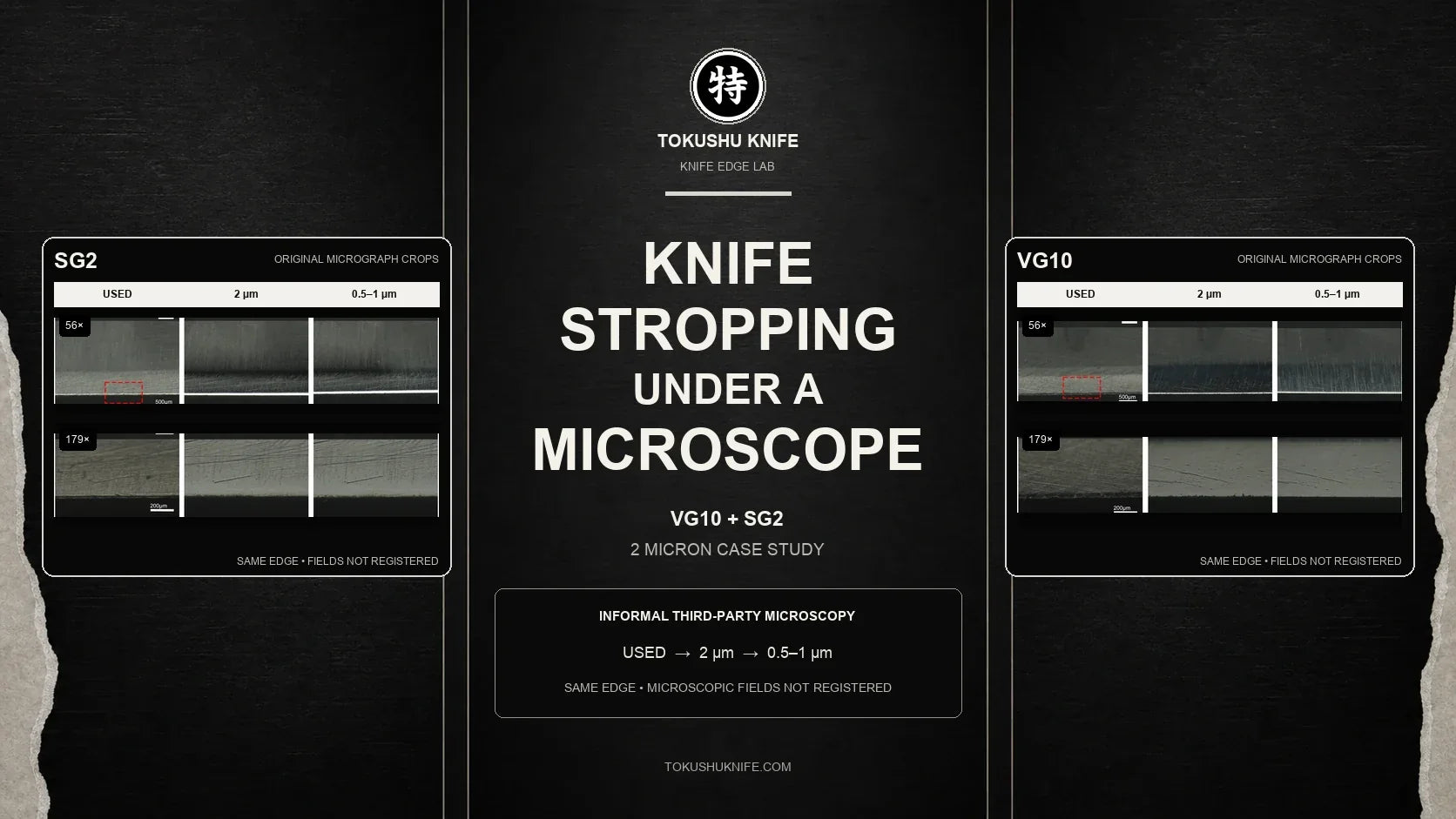
Resumen en lenguaje sencillo: Tokushu Knife encargó imágenes de microscopía de terceros de filos usados de cuchillos de cocina VG10 y SG2 antes y después de asentarlos con Tokushu Knife Strop Shots. En las zonas fotografiadas, los filos usados muestran más irregularidades visibles, mientras que las imágenes tomadas después de la etapa de 2 micras muestran un ápice de aspecto más limpio y continuo y un patrón de rayado diferente. Ese aspecto es coherente con un refinamiento abrasivo del filo. Por sí solo, no constituye una medición del afilado, la mordida, la fuerza de corte ni la retención del filo.
Divulgación comercial: Tokushu Knife vende el compuesto de asentado analizado aquí y lo suministró para esta comparación informal. La microscopía se realizó fuera de Tokushu Knife, pero no fue un estudio de laboratorio acreditado, una prueba de afilado estandarizada ni una investigación revisada por pares. Publicamos conjuntamente las observaciones útiles y las limitaciones para que los lectores puedan evaluar las pruebas por sí mismos.
Por qué publicamos las imágenes
La mayoría de los consejos sobre asentado pide a los clientes que acepten afirmaciones como «realinea el filo», «restaura el afilado» o «más fino siempre es mejor» sin mostrar qué ocurrió en el ápice. Estas imágenes permiten observar más de cerca filos representativos de VG10 y SG2 a lo largo de sucesivas etapas de mantenimiento.
La conclusión honesta es más limitada que una afirmación de marketing habitual: los filos analizados presentan diferencias visibles después del asentado con el abrasivo de 2 micras. Las imágenes ayudan a explicar el cambio superficial, pero el rendimiento funcional debe evaluarse mediante el comportamiento de corte o una prueba de afilado estandarizada.
Resumen del estudio de caso
- Referencia interna: TK-EDGE-CASE-01
- Aceros mostrados: filos de cuchillos de cocina VG10 y SG2/MC63
- Tratamiento principal: abrasivo policristalino Tokushu Knife Strop Shots de 2 micras sobre un asentador de cuero
- Secuencia: Se siguió el mismo filo a lo largo de las etapas sucesivas, salvo que la etiqueta de una figura indique lo contrario. El campo fotografiado no se registró como la misma ubicación microscópica exacta en todas las etapas.
- Vistas suministradas: 11,2×, 56× y 179×, con barras de escala impresas en las figuras
- Formato de la prueba: microscopía informal de terceros solicitada por Tokushu Knife
- Datos no registrados en un protocolo formal: modelo de microscopio, ángulo del filo, cantidad de compuesto, firmeza del cuero, presión, número de pasadas, método de limpieza, muestras repetidas y análisis estadístico
Cómo interpretar estas imágenes
La fila inferior ofrece la vista más cercana suministrada del ápice. Observe la continuidad y regularidad de la línea donde se unen los dos biseles, así como el patrón de rayado inmediatamente detrás. No interprete el grosor aparente de la línea brillante como una medición del radio del filo: la iluminación, el enfoque, la orientación y la ubicación exacta fotografiada pueden cambiar su aspecto.
La etapa final de «0,5–1 micra» de las composiciones suministradas se realizó después de la etapa de 2 micras sobre el mismo filo. Por tanto, se trata de una etapa de acabado secuencial, no de un control comparativo independiente. Como su etiqueta agrupa más de un valor de micras, no utilizamos esa columna para afirmar que un compuesto fino concreto superó al de 2 micras.
Observaciones sobre SG2/MC63

Qué se observa
- El filo usado analizado presenta un ápice visiblemente menos regular en la vista más cercana suministrada.
- Después de la etapa de 2 micras, el ápice fotografiado parece más continuo y uniforme.
- El patrón de rayado superficial detrás del ápice cambia después del asentado, lo que muestra que el abrasivo entró en contacto con la superficie del filo analizado y la modificó.
Qué inferimos y qué no
El cambio visual es coherente con el refinamiento del filo analizado por parte del abrasivo policristalino de 2 micras. La imagen no cuantifica cuánto aumentó el afilado del cuchillo, si mejoró la retención del filo ni si otro compuesto produciría un mejor rendimiento de corte.
Observaciones sobre VG10

Qué se observa
- El filo VG10 usado analizado muestra un ápice visiblemente irregular y desgastado en la vista más cercana suministrada.
- Después de la etapa de 2 micras, el ápice fotografiado parece más limpio y continuo.
- El bisel inmediatamente detrás del ápice muestra un patrón de rayado diferente y de aspecto más uniforme después del tratamiento.
Qué inferimos y qué no
Como en el ejemplo de SG2, el aspecto es coherente con el refinamiento abrasivo de este filo analizado. No demuestra que todos los cuchillos VG10 respondan de la misma manera ni que el asentado pueda reparar una mella o sustituir el afilado con piedras.
Lo que esta microscopía no demuestra
- No proporciona una puntuación numérica de afilado ni una medición de la fuerza de corte.
- No mide la retención del filo después de cortes repetidos.
- No establece que Tokushu Strop Shots supere a otra marca.
- No aísla las etapas de 2 micras y la etapa fina posterior como tratamientos independientes.
- No demuestra la eliminación de la rebaba desde todos los ángulos de observación.
- No permite generalizar estos filos representativos a todos los tratamientos térmicos, geometrías, aceros, asentadores o técnicas de usuario.
Esta distinción es importante. Los equipos para filos de cuchillo de CATRA miden el afilado y la durabilidad mediante pruebas de corte controladas conformes con BS EN ISO 8442-5. Un microscopio puede documentar el estado visible del filo, pero una afirmación sobre el rendimiento funcional requiere una prueba funcional.
Por qué Tokushu recomienda 2 micras para cuchillos de cocina
Nuestra recomendación práctica se basa en la experiencia de afilado y uso en cocina, no en pretender que una fotografía pueda medir la «mordida». Para la mayoría de los cuchillos de cocina japoneses, el compuesto de 2 micras es nuestra opción predeterminada para acabado y retoques porque recupera un filo de trabajo útil y con mordida. Es el tipo de filo que muchos cocineros buscan para la piel de tomates, pimientos, proteínas y la preparación diaria.
- Strop Shots de 2 micras: la recomendación predeterminada de Tokushu para cuchillos de cocina cuando se busca una mordida útil.
- 1 micra: también es adecuada para cuchillos de cocina cuando se prefiere un acabado algo más fino.
- Menos de 1 micra: principalmente para navajas de afeitar, acabados especializados o usuarios que buscan deliberadamente un bisel pulido a espejo. Un acabado más fino no es automáticamente mejor para preparar alimentos.
No recorra todos los tamaños de micra disponibles solo porque sea posible. Elija el acabado según el uso real que dará al cuchillo.
Cómo asentar sin redondear el ápice
- Utilice una superficie de asentado estable, firme y plana.
- Aplique una capa ligera y uniforme de compuesto. Una mayor cantidad no es necesariamente mejor.
- Realice pasadas alejando el filo y desplazando el lomo por delante del borde cortante. Nunca empuje el filo hacia delante contra el cuero.
- Mantenga un ángulo constante y aplique poca presión.
- En un cuchillo estándar de doble bisel, alterne los lados y compruebe el filo con frecuencia.
- Deténgase cuando recupere la mordida deseada y después limpie completamente la hoja antes de preparar alimentos.
No existe un número universal de pasadas. El acero, el estado del filo, el ángulo, la presión, la firmeza del cuero y el abrasivo influyen en el resultado. Una presión excesiva, un ángulo demasiado alto o un asentado innecesario pueden redondear el ápice y hacer que el cuchillo parezca menos afilado.
Cuándo no basta con asentar
Un asentador de cuero mantiene y refina un filo existente. Utilice piedras de afilar o un servicio profesional cuando el cuchillo esté mellado, muy desafilado, tenga biseles irregulares o no mejore tras un asentado breve y cuidadoso. La secuencia de reparación de mellas suministrada con este proyecto muestra cómo el daño visible desaparece durante las etapas con piedra, no gracias al asentador.
Explore nuestros asentadores de cuero y compuestos o contacte con el equipo de afilado de Tokushu si no sabe qué mantenimiento necesita su cuchillo.
Preguntas frecuentes
¿Demuestra la microscopía que los cuchillos quedaron más afilados?
No. Muestra una diferencia visible en las superficies de los filos analizados. Una afirmación sobre el afilado requiere una medición de corte o fuerza siguiendo un protocolo definido.
¿Fue una prueba de laboratorio independiente?
No. Tokushu Knife solicitó la comparación informal de microscopía de terceros y suministró el compuesto. No fue un estudio de laboratorio acreditado, estandarizado ni revisado por pares.
¿Por qué mostrar los resultados si la prueba fue informal?
Porque las imágenes son útiles cuando su alcance se explica con precisión. Publicar la relación comercial, el método disponible, las barras de escala originales y las limitaciones ofrece a los clientes más información que una afirmación de rendimiento sin fundamento.
¿Puede un compuesto de 2 micras reparar un cuchillo mellado?
No. Las mellas y un filo muy desafilado requieren eliminar material abrasivamente y reconstruir el filo con piedras o mediante un afilado profesional.
¿Por qué no recomendar 0,5 o 0,25 micras a todos los propietarios de cuchillos de cocina?
Esos compuestos más finos priorizan el pulido. Para el trabajo normal en cocina, un filo muy pulido no es automáticamente más útil que la mordida práctica producida por 2 micras, mientras que 1 micra sigue siendo una buena opción de acabado fino para cocina.
Referencias técnicas relacionadas
- John D. Verhoeven, Experiments on Knife Sharpening, 2004. Este informe técnico utilizó microscopía electrónica de barrido para examinar métodos de afilado, asentado en cuero, rebabas y compuestos de pulido de diamante. Aporta un contexto útil; no analizó Tokushu Strop Shots.
- CATRA, Automatic Edge Tester. CATRA explica cómo las pruebas de corte controladas miden el afilado inicial y la durabilidad del filo conforme a BS EN ISO 8442-5.
- McGorry, Dowd y Dempsey, A technique for field measurement of knife sharpness, Applied Ergonomics, 2005. El estudio relaciona la fuerza de corte medida con los cambios en el afilado de la hoja.
Qué probaremos a continuación
Un seguimiento más sólido debería registrar el cuchillo y su dureza, el estado inicial del filo, el ángulo, la superficie del asentador, la masa del compuesto, la presión, el número de pasadas, el procedimiento de limpieza y las mismas ubicaciones de imagen registradas. Debería incluir varias muestras y mediciones estandarizadas de afilado antes y después del asentado, seguidas de una prueba de retención del filo. Si realizamos ese trabajo, lo añadiremos aquí y conservaremos el historial de revisiones de esta página en lugar de reescribir las limitaciones originales.
Estado de la revisión: borrador inicial del estudio de caso. Los archivos de imagen, la fecha de publicación y las futuras correcciones se registrarán en esta página.

Dejar un comentario
Este sitio está protegido por hCaptcha y se aplican la Política de privacidad de hCaptcha y los Términos del servicio.