Article: Toru Tamura: From Calgary to Tetsujin Hamono

Toru Tamura: From Calgary to Tetsujin Hamono
Fact-checked and updated August 29, 2026.
Toru Tamura (田村 徹) is the Japanese blacksmith behind Tetsujin Hamono. His documented path into knife making runs from materials engineering and a working holiday in Calgary to apprenticeships in Echizen and later collaboration with sharpener Naohito Myojin.
Documented background and training
A 2015 profile and interview from At Home’s Ashita e no Tobira records that Tamura was born in Ehime in 1988 and studied materials engineering for five years at Niihama National College of Technology. It also documents his move to Canada, where exposure to Japanese kitchen knives helped shape his decision to enter the trade.
According to his former employer’s Tetsujin Hamono profile, Tamura worked at Knifewear in Calgary around 2008–2009. After returning to Japan, he trained under Hiroshi Kato at Takefu Knife Village and later under Masaji Shimizu, whose work included traditional single-bevel knives. The 2015 At Home profile places Tamura about five years into the trade at that time.
Tetsujin Hamono: who does what?
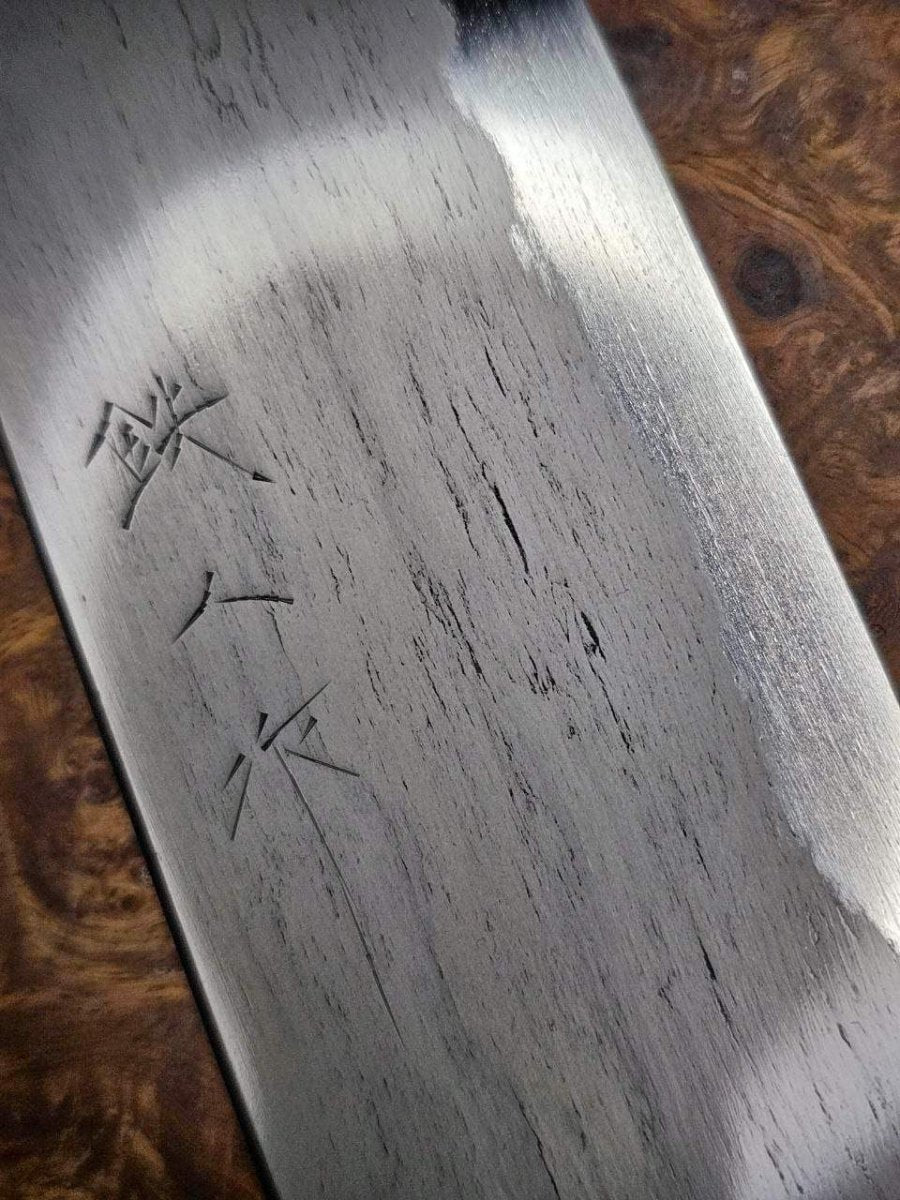
Tetsujin Hamono began in the late 2010s as a collaboration between Tamura and Naohito Myojin. In the documented division of work, Tamura forges the blades, while Myojin sharpens and finishes them. That distinction matters: forging, grinding, sharpening, and finishing are separate stages, so credit should follow the role performed.
Tetsujin is not a Blue #2-only line. Current documented models include both Aogami #2 carbon steel and Ginsan #3 stainless steel. Steel, finish, dimensions, and availability should therefore be checked on the individual product page rather than inferred from the Tetsujin name.
What about Hatsukokoro Shirasagi?
Specialist retailer documentation attributes the Blue #2 single-bevel Shirasagi line commissioned by Hatsukokoro to Tamura as blacksmith and Tateo Myojin as sharpener. This is a separate project from Tetsujin Hamono, and maker roles can vary by line or model.
On the cited Shirasagi line, ni-mai means a two-layer laminated construction: hard cutting steel joined to softer iron cladding. It is a construction description, not a synonym for “double forging,” and it does not mean every knife associated with Tamura is single-bevel or ni-mai.
How to shop Toru Tamura knives
- Confirm the steel: Aogami #2 is carbon steel; Ginsan #3 is stainless.
- Confirm the bevel: single-bevel knives require handedness and technique considerations that double-bevel knives do not.
- Confirm the maker roles: the blacksmith and sharpener may differ by line.
- Use the individual specifications: dimensions, finish, handle inclusion, and stock can change by model.
Browse the Toru Tamura collection. For the most accurate buying decision, treat each product page as the controlling record for that exact knife.
Frequently asked questions
Who makes Tetsujin Hamono knives?
Toru Tamura is documented as the blacksmith, while Naohito Myojin sharpens and finishes the blades.
Are all Tetsujin knives made from Blue #2 steel?
No. Documented Tetsujin models include Aogami #2 and Ginsan #3, so check the exact model.
Are all Toru Tamura knives single-bevel?
No. His training includes traditional single-bevel work, but Tetsujin also includes double-bevel kitchen knives.
Is Shirasagi the same as Tetsujin?
No. They are distinct lines with different documented production arrangements. Do not transfer a maker or sharpener attribution from one line to another without model-level support.
Sources
- Ashita e no Tobira #070: Toru Tamura — 2015 interview and biographical profile.
- Knifewear: Blacksmith Profile — Tetsujin Hamono — former-employer account of Tamura’s Calgary period, apprenticeships, and Tetsujin role split.
- Knives and Stones: Hatsukokoro Shirasagi Blue #2 — specialist documentation for the cited Shirasagi line.
Prepared by Anthony Maciejewski, Founder and Director of Tokushu Knife. We separate documented facts from model-specific seller attribution and revise profiles when stronger source material becomes available.
%20is%20the%20Japanese%20blacksmith%20behind%20Tetsujin%20Hamono.%20His%20documented%20path%20into%20knife%20making%20runs%20from%20materials%20engineering%20and%20a%20working%20h...)
Leave a comment
This site is protected by hCaptcha and the hCaptcha Privacy Policy and Terms of Service apply.